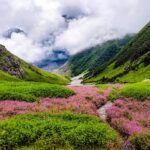
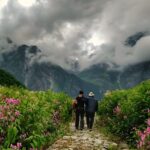
Valley of Flowers trek is indeed one of The Most Beautiful Trek in Uttarakhand. It is situated in the Chamoli district and is listed as a UNESCO World Heritage Site under the Criterion (vii) and Criterion (x). The covers 87 square kilometers, inhabited by numerous species of rare and endangered flora and fauna such as Blue Poppies, Brahmakamal, Cobra Lily, Primula, Asiatic Black Bear, Snow Leopard, Blue Sheep, musk bear, and brown bear to red fox, Himalayan birds etc.
What makes this trek uniquely special is the story behind its discovery. The Valley was completely unknown to the outside world until 1931, when British mountaineer Frank S. Smythe and his team accidentally stumbled upon it after losing their way during a climbing expedition.More than 90 years later, people come from every corner of the globe to lose themselves here — intentionally this time.
Over 500 species of rare and colorful flowers bloom here, including the iconic Brahma Kamal and Himalayan Blue Poppy, and the trail also gives you a chance to spot elusive wildlife like the Himalayan Monal and Snow Leopard. Whether you’re a seasoned trekker or someone lacing up hiking boots for the very first time, the Valley of Flowers has something profound to offer.
A UNESCO World Heritage Site Like No Other
Not every trail carries the weight of global recognition. The Valley of Flowers Trek 2026 takes you through a landscape that has been formally acknowledged by the world as irreplaceable. The Valley was made a core zone of the Nanda Devi Biosphere Reserve in 2000, and UNESCO added the entire reserve to its Man and Biosphere network in 2004, protecting it under several international conservation mandates.
This means that when you walk here, you’re walking through carefully regulated, lovingly preserved terrain where the natural ecosystem has been shielded from mass exploitation. Strict limits on group sizes, waste disposal regulations, and contributions to local communities are all part of what makes this trek genuinely sustainable and responsible. Think of it as the Louvre of the Himalayas — except the art is alive, blooming, and changes color every two weeks throughout the season.
Best Time to Visit Valley of Flowers Trek in 2026
One of the most common questions people ask is: when exactly should I go? And while most travel blogs will lazily say “July to August,” the reality is much richer and more nuanced than that. The valley essentially tells a different story depending on which week you arrive, and knowing this can transform a good trip into an absolutely unforgettable one.
The Valley of Flowers opens around June 1st every year and remains accessible until October 31st, weather permitting, with the best time to see the valley in full bloom being mid-July to mid-August, when over 500 species of flowers create a carpet of colors across the meadows. But within that window, each month has its own personality.
Month-by-Month Breakdown
Here’s how the Valley of Flowers Trek season unfolds in 2026, week by week, so you can make a genuinely informed decision:
| Month | Bloom Level | Crowds | Weather | Best For |
|---|---|---|---|---|
| Early June | Low (snow patches) | Minimal | Cool, partly cloudy | Solitude, early primulas |
| Late June | Moderate | Low | Unpredictable | Budget travellers |
| July | High & building | Medium | Heavy monsoon | Blue Poppies, fewer crowds |
| August | Peak bloom | High | Very rainy | Maximum flower diversity |
| September | Reducing | Low | Clearer skies | Photography, mountain views |
In June, the valley is just opening, snow patches may still be present, and early wildflowers like primulas and anemones are beginning to appear, with fewer crowds than the peak months. By July, the bloom accelerates rapidly, with Brahmakamal, blue poppy, and dozens of other species carpeting the valley floor, though monsoon rains are frequent.
August represents peak bloom with the highest density of flowers, but also the peak monsoon, so expect rain on most days and slippery trails. September, which is often overlooked, is genuinely underrated. Trekkers who prioritise clear mountain views and photography, anyone who wants Hemkund Sahib without the August pilgrim surge, and budget travellers who want better accommodation rates will find September particularly rewarding.
The Brahma Kamal Window: Don’t Miss It
If there’s one flower that almost every trekker dreams of seeing in the Valley of Flowers, it’s the Brahma Kamal — Uttarakhand’s state flower and one of the rarest blooms in the alpine world. If you are trekking in August, you can stumble upon the sacred Brahma Kamal along the way, particularly on the trail toward Hemkund Sahib. This mystical, white lotus-like flower typically blooms in late July and peaks through mid-August. Missing this window means you’ve visited the valley without experiencing its most legendary floral offering. Plan your dates carefully around this, and you’ll understand why trekkers talk about this experience for years afterward.
Route Details for the Valley of Flowers Trek
Understanding the route before you start is half the battle won. The Valley of Flowers Trek isn’t a single trail but a sequence of legs, each with its own character, challenge level, and visual reward. Think of it like chapters in a book — each one building toward the grand finale that is the valley itself. The good news is that this trek is remarkably well-organized, with a clearly defined path that even first-timers can navigate confidently, especially with a guide.
How to Reach the Starting Point
Getting to the trailhead requires a bit of planning since the valley sits deep in the Garhwal Himalayas, far from any major city. The starting point is Haridwar or Rishikesh, and from there the route goes to Govindghat or Karchi, with the nearest airport being Jolly Grant Airport in Dehradun, which is well connected to major Indian cities, while the closest railway station is Rishikesh.
From Rishikesh or Haridwar, you’ll hire a taxi or take a shared cab to Govindghat, a journey that typically takes 10 to 12 hours through some of the most breathtaking mountain roads in the country. The route from Rishikesh passes through Devprayag, Rudraprayag, and Joshimath, with stunning mountain and river views accompanying you for most of the drive. Don’t underestimate this road journey — it’s long, the roads are winding, and it’s absolutely gorgeous.
The Complete Trail from Govindghat to the Valley
The trek begins at Pulna, from where trekkers embark on a 9 km walk to Ghangaria, a quaint village at 3,000 metres that serves as the base for both the Valley of Flowers and the Hemkund Sahib trek, with the trail to Ghangaria offering a mix of steep ascents, dense forests, and occasional waterfalls. Ghangaria is your home base for the heart of the trek. It’s a small but surprisingly well-equipped village where you’ll find guesthouses, dhabas, and even basic medical support.
From Ghangaria, the Valley of Flowers is about 4 km away, an uphill walk that opens dramatically into the floral panorama you’ve been dreaming about. The trek to the Valley of Flowers follows a clearly defined stone-paved path until the final stretch, while the trails toward the valley itself are uneven and rough, making good footwear absolutely essential.
For those adding Hemkund Sahib to their itinerary and you really should the steep 6 km climb to Hemkund Sahib at 4,329 metres is both a spiritual and physical highlight, surrounded by seven snow-covered peaks, with the glacial lake and Gurudwara creating a serene ambiance that many trekkers describe as the emotional peak of their entire journey.
What You’ll See Along the Route
The trail is a geography lesson, a botany class, and a photography masterclass all rolled into one. The journey offers panoramic views of peaks like Nilgiri Parvat, Gauri Parvat, and Rattaban, and key attractions include Laxman Waterfall, the Pushpavati River, rare flora and fauna, and the spiritual landmark of Hemkund Sahib.
The Pushpavati River runs right through the valley, and walking alongside it is one of those simple joys that reminds you why you came. The valley at 3,600 metres unfolds into a surreal carpet of over 600 species of wildflowers during the monsoon, with orchids, primulas, zinnias, and lilies bursting into color, creating an experience that is especially magical when mist settles over the meadows in the afternoon.
Complete 6-Day Valley of Flowers Trek Itinerary 2026
Here’s a practical, realistic itinerary that balances exploration with recovery time. Remember, acclimatization is not optional at these altitudes it’s survival strategy.
Day-by-Day Breakdown
Day 1 — Arrive in Rishikesh / Haridwar
Your adventure begins before you even set foot on a trail. Arrive in Rishikesh or Haridwar by evening. This is your chance to rest, hydrate well, and pick up any last-minute supplies you might have missed. If you’re arriving from Delhi, you can attend the Ganga Aarti ceremony at the Ganga Ghat in Rishikesh in the evening, which is a beautiful way to set the spiritual tone for the journey ahead. Get to bed early tomorrow is a long day on the road.
Day 2 — Drive from Rishikesh to Govindghat (approximately 250–290 km)
This is a full-day drive that winds through some of the most spectacular mountain scenery in India. Your group will be picked up early in a pre-booked vehicle, passing through Devprayag and Rudraprayag, arriving at Govindghat by evening for accommodation in a guesthouse, a trek briefing, dinner, and an early rest. Use this day to observe the landscape, eat well, and drink plenty of water. The altitude starts climbing here, and your body needs to start adjusting.
Day 3 — Trek from Pulna to Ghangaria (9–13 km, 5–6 hours)
This is your first real trekking day, and it sets the tone beautifully. Depending on traffic and permissions, your group may drive a short distance to Pulna to reduce the walking distance, with the route being picturesque along rivers, waterfalls, and apricot trees, and qualified trek leaders accompanying you throughout.
The trail gains elevation steadily, and you’ll cross wooden bridges, pass local dhabas, and get your first glimpse of the raw Himalayan wilderness. Reaching Ghangaria in the late afternoon feels like a genuine achievement, and the warm tea and dinner waiting for you taste like the best meal you’ve ever had.
Day 4 — Ghangaria to Valley of Flowers and Back (8 km round trip, 6–7 hours)
This is the day you’ve been building toward. Wake up early, eat a solid breakfast, and start moving toward the valley entrance. Entry passes will be arranged by your team; a short walk followed by a gradual climb takes you to the valley, which is filled with hundreds of wildflower species, streams, and snowy landscapes in the background, giving trekkers plenty of time to wander, photograph, and absorb the surroundings before returning for a packed lunch and the walk back to Ghangaria. Spend at least 2–3 hours inside the valley itself. Explore slowly, breathe deeply, and resist the urge to rush from one photo spot to the next.
Day 5 — Ghangaria to Hemkund Sahib and Back (12 km round trip, 7–8 hours)
This is a challenging but deeply satisfying day that starts at 6 AM, trekking up to Hemkund Sahib the world’s highest Gurudwara at 14,200 feet situated amidst a glacial lake surrounded by seven peaks, with hot tea and langar (community kitchen food) awaiting you at the top before the return to Ghangaria by afternoon.
Physically, this day is the hardest of the trek due to the steep gradient and altitude. Spiritually and visually, it is arguably the most powerful. Even if you’re not a Sikh pilgrim, standing at the edge of that glacial lake with the snow-capped peaks reflected in the water creates a silence inside you that is hard to describe and impossible to forget.
Day 6 — Ghangaria to Govindghat and Drive Back to Rishikesh
The final day involves trekking from Ghangaria back down to Govindghat and then driving to Pipalkoti or all the way back to Rishikesh or Dehradun. The descent is faster than the climb, usually taking 3–4 hours. The long drive back gives you time to decompress, flip through your photos, and begin processing what you’ve just experienced. Most groups reach Rishikesh or Haridwar by late evening.
Valley of Flowers Trek 2026: Full Budget Breakdown
Let’s get honest about money, because this is where a lot of first-time trekkers get caught off-guard. The Valley of Flowers Trek 2026 is genuinely one of the most affordable Himalayan treks in India — but only if you plan it right. There are two main ways to do this trek: independently (budget style) or through a trekking package, and each has very different cost implications.
Budget vs. Package Trekking: What Makes Sense for You?
Trek operators offer all-inclusive packages ranging from ₹10,000 to ₹15,000 per person for a 5–6 day itinerary, which includes accommodation, meals, guide, and permits, while independent trekkers who plan carefully will find that the experience doesn’t have to burn a hole in their pocket. Here’s a realistic breakdown of what a budget-conscious independent trekker from Delhi will spend in 2026:
| Expense Category | Budget Option | Mid-Range Option |
|---|---|---|
| Delhi–Rishikesh–Delhi (train/bus) | ₹800–₹1,200 | ₹1,500–₹2,500 |
| Rishikesh–Govindghat–Rishikesh (shared taxi) | ₹1,000–₹1,500 | ₹2,000–₹3,000 |
| Accommodation (5 nights, shared) | ₹1,500–₹2,500 | ₹3,000–₹5,000 |
| Meals (5 days) | ₹1,500–₹2,000 | ₹2,500–₹4,000 |
| Entry permit (₹150/day, 2 days) | ₹300 | ₹300 |
| Guide (optional, ₹2,000/day) | — | ₹4,000–₹6,000 |
| Miscellaneous | ₹500–₹800 | ₹1,000–₹2,000 |
| Total Estimate | ₹5,600–₹8,300 | ₹14,300–₹22,800 |
When organized by a trekking organization, the median Valley of Flowers Trek package falls in the range of ₹7,000 to ₹12,000, which typically includes a professional trek leader and support staff, as well as forest permits and fees. For foreign nationals, an additional ₹2,000 permit fee is applicable, which is not included in the standard trek cost.
Hidden Costs First-Timers Always Miss
The budget table above gives you the bones, but experienced trekkers will tell you there are a handful of expenses that almost always catch newcomers off-guard. First, there’s gear. If you don’t own trekking equipment, you can rent high-quality gear like trekking shoes, backpacks, and jackets from gear rental stores, which costs less than ₹2,000 for the entire trek, making rental both more affordable and environmentally friendly.
Second, there’s the helicopter option. If you take the helicopter to Ghangaria, add ₹7,000–₹10,000 for a round trip a popular choice for older trekkers or those with limited time. Third, consider the backpack offloading service if your fitness level doesn’t allow you to carry a heavy pack this service is available for ₹500 per bag per day and is worth considering if you have back issues. Finally, budget for a Badrinath extension if you can a sharing taxi from Govindghat to Badrinath costs approximately ₹500 both ways per person and adds enormous cultural value to your trip.
Travel & Trekking Tips for Valley of Flowers Trek
Knowing the route and the budget gets you started, but knowing how to actually show up on this trek — physically, mentally, and logistically — is what separates a smooth, joyful experience from a miserable, underprepared one. Let’s make sure you belong firmly in the first camp.
Fitness Preparation & Gear Checklist
The Valley of Flowers Trek is officially rated as easy-to-moderate, which is genuinely good news. It is appropriate for beginners, requiring no technical climbing, though the Hemkund Sahib trail is a steep 6 km one-way uphill that requires good individual stamina, and the trek involves anywhere between 6 and 10 km of walking per day across several consecutive days on steep, stony, and often slippery monsoon trails.
The practical benchmark for readiness is simple: you should be able to cover 4 km of distance in 30 minutes without stress and carry a 10–15 kg backpack comfortably. If you can’t yet, you’ve got time before the season opens in June 2026. Start building your cardio with daily walks, stair climbing, and weekend hikes.
Your gear checklist for this trek should include waterproof trekking shoes (non-negotiable given the monsoon conditions), a good rain poncho or jacket, thermal layers for Hemkund Sahib day, trekking poles for the slippery descents, a 40–50 litre backpack, water bottles (at least 2 litres capacity), and a small first aid kit with essentials.
A strip of Diamox (125 mg, taken every 12 hours starting from Delhi) can significantly reduce the chances of Acute Mountain Sickness on the trek — though always consult your doctor before beginning a Diamox course. Don’t forget sunscreen, lip balm, and an anti-fungal powder for your feet, which will be wet for most of the trek.
Altitude Sickness: Prevention and What to Do
Altitude sickness is the silent saboteur of many Himalayan treks, and the Valley of Flowers Trek 2026 is no exception. The valley itself at around 12,000 feet altitude will produce slight symptoms of AMS (Acute Mountain Sickness) in some trekkers, while Hemkund Sahib at 14,200 feet is a serious ascent that requires both fitness preparation and altitude awareness.
The symptoms to watch for include persistent headaches, nausea, dizziness, loss of appetite, and unusual fatigue. The golden rule is simple: if you feel any of these symptoms, don’t push higher. Descend, hydrate, rest, and let your body catch up.
Trekking in a group with a certified guide is invaluable here because experienced trek leaders can spot early signs of AMS before you do. Reputable trekking companies keep oxygen cylinders checked and ready at campsites and carry them with the team at all times, providing an important safety net in high-altitude emergencies.
Responsible Trekking in a Protected Zone
The Valley of Flowers is not just a pretty destination it’s a living, breathing, fragile ecosystem that needs your active cooperation to survive. Valley of Flowers is a protected national park where entry is not free, and you cannot walk in without a permit, which can be obtained at the Forest Department counter in Ghangaria, the base village, with entry gates opening at 7:00 AM and last entry at 2:00 PM, and all visitors required to exit the valley by 5:00 PM.
Beyond the permit rules, the ethics of trekking here demand that you carry all your waste out, stay on marked trails at all times, never pick flowers or disturb plant life, avoid loud music or noise inside the valley, and minimize single-use plastic by carrying reusable water bottles.
Trekkers are advised to avoid consumption of alcohol or any other intoxicants during the trek, and to pay heed to trek leaders and guides in order to ensure a safe and sound experience for everyone involved. The valley has survived and thrived for thousands of years; your role is to ensure it continues to do so for the thousands of trekkers who will follow in your footsteps.
One last tip that every experienced trekker will agree on: book early. High demand, especially during weekends and around the Independence Day long weekend, means trek slots often get sold out 30 to 40 days in advance, making early booking absolutely imperative for securing your preferred dates. The Valley of Flowers season is shorter than most people realize, and the best dates fill up fast. Whether you’re booking through an operator or planning independently, have your dates locked in by May at the latest.
Conclusion
The Valley of Flowers Trek 2026 is one of those rare travel experiences that genuinely lives up to its reputation and in many ways, exceeds it. This isn’t just a trail through pretty meadows. It’s a journey through a UNESCO World Heritage Site of extraordinary ecological importance, a spiritual climb to one of the world’s highest Gurudwaras, a monsoon adventure through the raw heart of the Himalayas, and a deeply personal test of your physical and mental endurance.
Whether you visit in July for the riot of peak bloom, in August for the sacred Brahma Kamal, or in September for the crystalline mountain views, the valley will give you something you didn’t expect. It always does. Pack your bags, book your dates before they’re gone, train those legs, and get yourself to Uttarakhand. Some experiences simply cannot be put off — the flowers will bloom with or without you, but imagine how much better it feels when you’re standing right there in the middle of them.
FAQs
1. Is the Valley of Flowers Trek suitable for complete beginners?
Yes, the Valley of Flowers Trek is considered easy-to-moderate and is one of the most beginner-friendly Himalayan treks in India. You don’t need any prior trekking experience, but you do need basic cardiovascular fitness. The ability to walk 4 km in 30 minutes without exhaustion is a good benchmark. If the Hemkund Sahib climb is on your itinerary, a slightly higher fitness level is recommended given the steep 6 km ascent to 14,200 feet.
2. Do I need a permit for the Valley of Flowers, and how do I get one?
Yes, a forest entry permit is mandatory to enter the Valley of Flowers National Park. You can obtain it at the Forest Department checkpoint in Ghangaria, the base village just 4 km before the valley entrance. You’ll need a valid government-issued ID (Aadhaar, Voter ID, or Passport) and passport-sized photographs. The entry fee for Indian nationals is ₹150 per day, with an additional ₹2,000 for foreign nationals. Online booking is now available through the Uttarakhand Forest Department portal.
3. Can I do the Valley of Flowers Trek independently, without a guide?
Yes, independent trekking is permitted. The trail is well-marked and relatively easy to follow. That said, a certified local guide adds significant value, especially for identifying rare flower species, navigating the monsoon trail conditions safely, managing early signs of altitude sickness, and enriching the overall experience with ecological and cultural context. If you’re a first-time Himalayan trekker, strongly consider hiring a guide for at least the Hemkund Sahib day.
4. What is the best month for maximum flower diversity in the Valley of Flowers in 2026?
The absolute peak of flower diversity is typically the last week of July through the first two weeks of August, when over 500–600 species of alpine flowers are simultaneously in bloom. This is also when the Brahma Kamal Uttarakhand’s iconic state flower makes its appearance. If your priority is seeing the maximum variety of blooms, target this specific window. Be prepared for heavy monsoon rain and plan your gear accordingly.
5. How far in advance should I book the Valley of Flowers Trek 2026?
For peak dates particularly the last two weeks of July and the first two weeks of August, and especially around the Independence Day long weekend book at least 30 to 40 days in advance. Popular trekking operators fill up their slots quickly, and accommodation in Ghangaria is limited. If you’re targeting late June or early September, you have more flexibility, but booking 2–3 weeks ahead is still a smart move to secure your preferred accommodation and guide.